
Finding Dundalk Residents by Record
Dundalk has no city hall of its own. It is an unincorporated Baltimore County community. That shapes where the useful records live. A house number works well as a first key. Feed it into the county house-number layer or the Maryland State Department of Assessments and Taxation. Then carry the parcel or deed reference into the next source. A name with an exact date of birth and ZIP fits the Maryland State Board of Elections lookup, which offers a tightly controlled confirmation. For an earlier household, set a directory, census page, newspaper item, or recorded land instrument from the same period side by side.
Each record type describes a different relationship. A deed names its recorded parties. An assessment record keeps the premises apart from a mailing address. A directory shows a published address for one year. No single source proves who physically lives somewhere now. Write down the source date and the field behind each conclusion.
- Normalize the address in the Baltimore County GIS service.
- Search the address in SDAT Real Property Search and copy the deed reference.
- Use book and page or party names in MDLandRec.
- Use the exact name, date of birth, and ZIP in the state voter lookup only when those fields are known.
- Pair past-household results with a directory, census, newspaper, estate, or archive source.
Dundalk Records Offices and Custodians
Dundalk record work mostly leads to Baltimore County offices in Towson or to state portals. The County Courts Building handles land records, judicial records, and probate in person. Check the State assessment search and the county GIS before any visit. They supply the property identifiers a clerk or an index will ask for. A written request under the Maryland Public Information Act should name a custodian and an existing record. Include an address, date range, and record type. The law does not obligate an agency to build a new residents directory. Ask for documents, not research.
Baltimore County Circuit Court Clerk, Land Records
401 Bosley Avenue
Towson, MD 21204
410-887-2651
Maryland SDAT Property Search
Statewide assessment portal
Baltimore County selection
Address, account, or map search
Maryland State Board of Elections
Controlled voter-record lookup
First name, last name, date of birth, ZIP
Exact-match verification
Baltimore County Register of Wills
County Courts Building, Room 500
Towson, MD 21204
410-887-6680
Dundalk Address Records Before Names
SDAT offers no search by owner name, town, subdivision, or ZIP. It takes Baltimore County plus a street address or street name. Alternatively, use a property account identifier or a map reference. Type the full street name. Drop directions and suffixes when SDAT instructs you to. If a historic spelling fails, apply the documented asterisk truncation. One validated address beats a broad name search. It links the assessment record straight to the parcel and deed trail.
| SDAT field or control | How it works | Dundalk use |
|---|---|---|
| County | Required selection | Choose Baltimore County, not Baltimore City. |
| Search method | Address, account identifier, or map reference | Begin with the street address when it is known. |
| Street address or name | Conditional text field | Use the normalized house number and street name. |
| Owner name and ZIP | Not available as search modes | Do not expect a Dundalk-wide owner or ZIP roster. |
The results page separates owner name, mailing address, premises location, transfer date, and deed reference. A mailing address can sit anywhere. The principal-residence flag is an assessment field, not an occupancy roster.
Dundalk Parcel Fields as a Trail
The county GIS bridges a house number and a parcel record. Its parcel layer carries tax and parcel identifiers, owner and mailing fields, premise address, map, grid, lot, deed reference, value, year-built, census-block, and district fields. The house-number layer holds a different set: address, ZIP, postal city, coordinates, active status, and public-service geography. Check the point against the parcel boundary. Address ranges and multi-unit structures cause mismatches. Treat the two layers as one property only after they agree.
The official parcel-layer field view shows what the service exposes. That field list explains why a parcel result still needs a second check in SDAT. After that, pull the recorded instrument itself. GIS is a mapping and attribute tool. It is not certified title.
Current Dundalk Resident Directory Sources
A current Dundalk residents directory is really a set of narrow official sources. No single file holds everyone. Match the source to the actual question, and respect its limits. The voter lookup answers an exact identity match. Property and GIS records show a recorded owner or address relationship. The deed index lists parties to an instrument. Probate and court indexes record legal events rather than a current address. The broader voter-file route runs on its own statutory and application rules.
| Source | What it can confirm | Keeper | Access |
|---|---|---|---|
| SDAT and county GIS | Property, premise, owner-of-record, deed bridge | SDAT and Baltimore County | Online address and map tools |
| Voter Lookup | Exact registration match | Maryland State Board of Elections | Name, DOB, and ZIP check |
| MDLandRec | Recorded parties and instruments | Maryland State Archives / Circuit Clerk | Free account and MFA |
| Estate Search | Estate parties, status, and dates | Register of Wills | Public index, 1998 forward |
| Local history holdings | Dated household and neighborhood clues | BCPL, HSOBC, DPNHS | Online, in person, or assisted access |
Looking for one person rather than a property or a street? Use the focused Dundalk resident lookup process to cross-check the indexes that matter.
Dundalk Voter Records Need Exact Fields
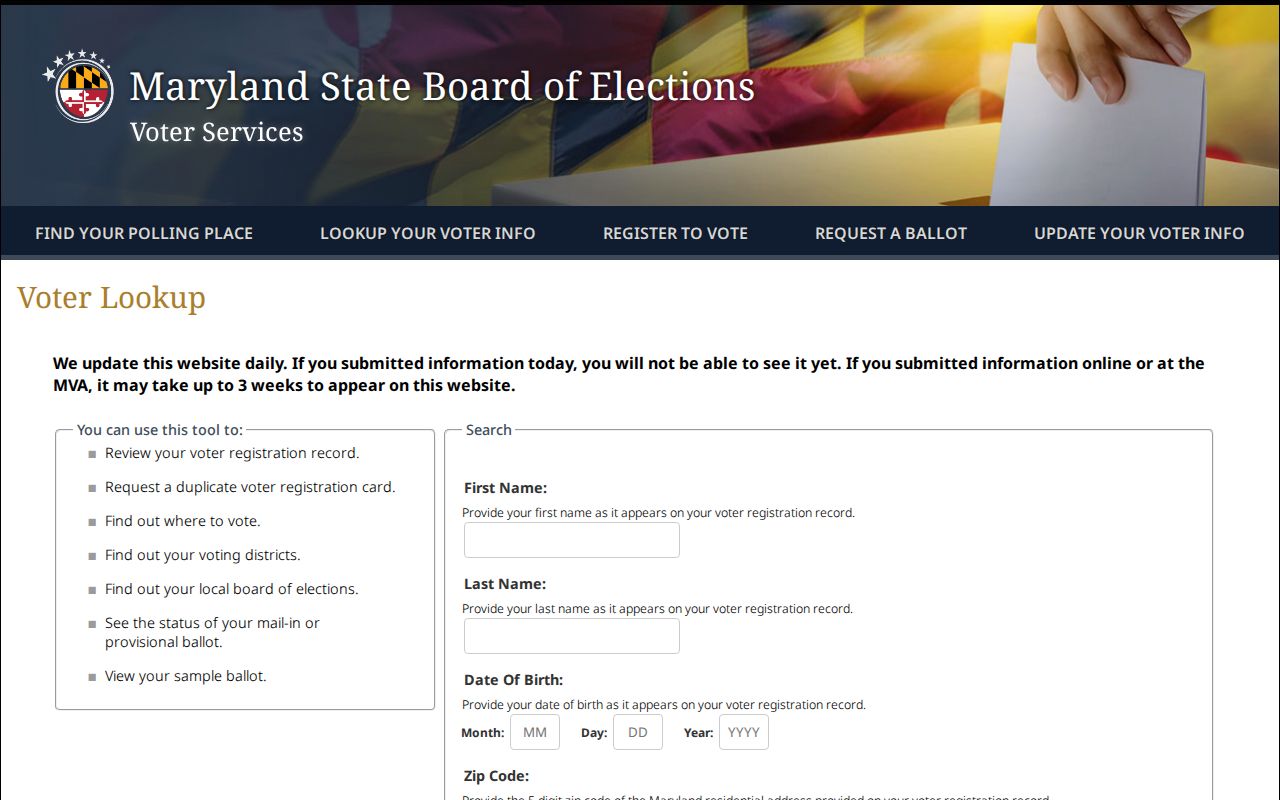
The Maryland voter lookup asks for first name, last name, date of birth, and ZIP. Street number and middle initial can sharpen the match. It checks one registration record at a time. It cannot download a whole neighborhood. The polling-place tool works the other way, taking street number, street name, and ZIP to return election geography. Read both as dated election records.
Maryland Election Law §3-506 restricts how voter lists are distributed and used. The broader list route requires a written application and a sworn statement. Some voters are protected, including Safe at Home participants. A missing search result must never be used to reconstruct them.
The Maryland Voter Lookup presents that exact multi-field form.
Same-name collisions are common. Use the date of birth and ZIP to separate them. Even a clean match needs a second source before any address or historical link counts as fact.
Dundalk Deed References Across Time
A book and page number from SDAT or GIS is only a starting point. MDLandRec turns it into a recorded instrument. The current system uses an account with MFA, and its updated interface separates Active Indices from Historical Indices. Party searches fail for dull reasons. Try spelling variants, initials, or spouse and corporate forms. The historical index helps too. Read the image sequence in order. Record the grantor, grantee, instrument date, legal description, and any earlier reference the instrument cites. A book/page jump is a locator, not a conclusion, so the deed chain still has to be read in full. Baltimore County lacks the consistent address indexing Baltimore City enjoys in this system, which is why the address-to-SDAT-to-book/page sequence matters; the full named-street workflow belongs on the Dundalk street directory page.
Dundalk Court and Estate Index Limits
Maryland Judiciary Case Search indexes cases; it is not the file itself. Sealed, shielded, and juvenile matters stay out. Protected cases of other kinds may not appear either. A listed party can be an attorney, an agent, or a business. It can also be someone tied to an event rather than a current resident. The March 2026 Case Search and Record Portal change also alters screen labels. Access paths may differ from older instructions as well. When a result matters, pull the case number. Then follow clerk procedure for the underlying file.
Estate Search is narrower but useful. It accepts name, county, status, date, type, and party filters. It covers estates from 1998 forward, and it updates daily. Results cap at 500. An estate notice can date a transfer. It can also explain a disappearance from a residents directory. Still, it never replaces the deed chain.
Dundalk Records for Family Connections
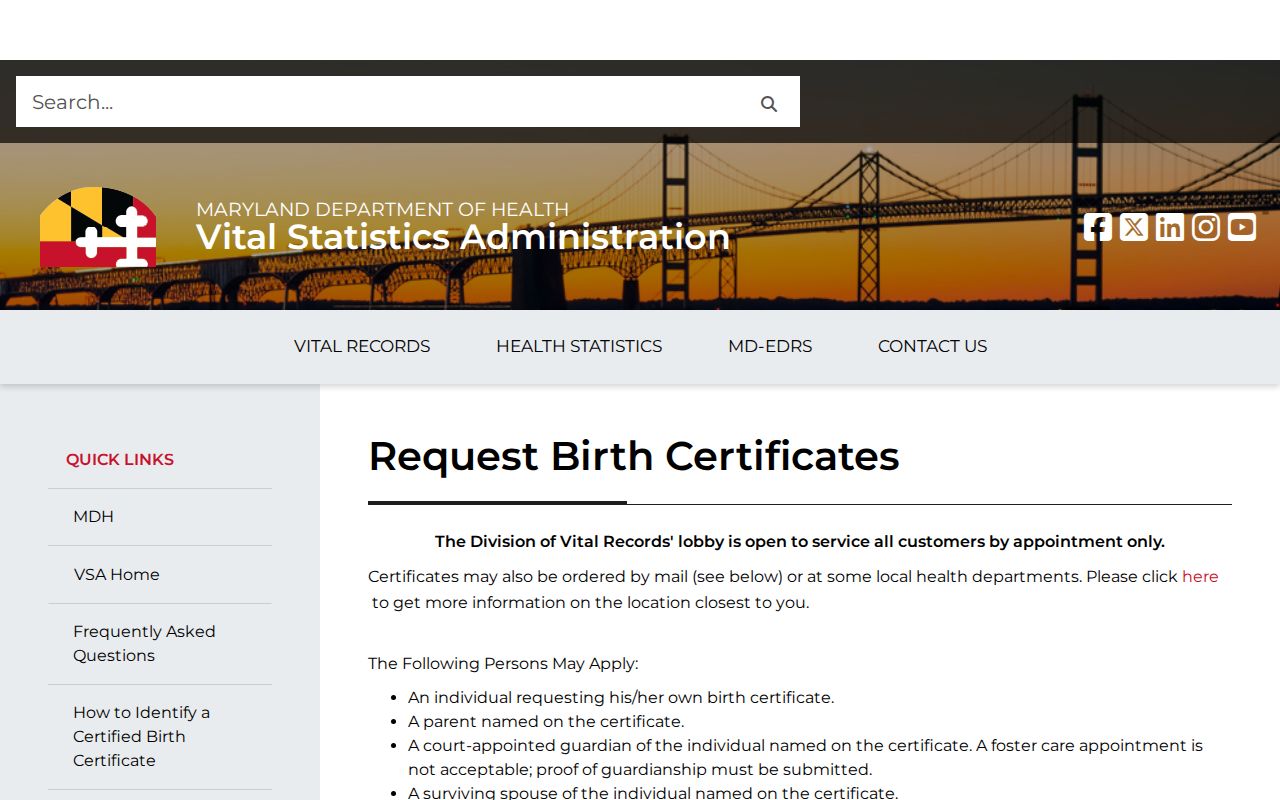
Recent vital certificates are not an open residents directory. Maryland Department of Health rules limit who may request them. The record type matters. So does the event date. Current birth, death, marriage, and divorce requests go through the Department's stated channels, while older historical material sits with the Maryland State Archives under its own access rules. The law draws hard lines. Birth records less than 100 years old and death records less than 10 years old are restricted under State Government §9-1015. The official Maryland birth-record page spells out eligibility and application routes rather than an open name index.
Family history begins with open clues: a directory entry, a newspaper item, a census line, a death index hit, or an estate notice. Use the certificate or Archives process only when eligible.
Dundalk Historical Directory Shelves
Older Dundalk residents surface through a regional collection rather than one complete local run. Maryland State Archives lists Baltimore City, suburban, business, and telephone directories. The R.L. Polk series helps. Its 1896 through 1899 volumes explicitly cover suburban towns such as Dundalk. The 1901 digitized volume goes further. It carries a Dundalk village locator, and its entries separate occupation, work location, and home with an h marker. The 1928 milestone is the first criss-cross street directory by address.
BCPL offers catalog, local-history, database, and librarian-help routes. North Point is closed for renovation. Sollers Point, remote access where a database allows it, and local historical societies serve as fallbacks, and the Dundalk city directory page explains the volumes and reading methods in detail.
Dundalk Place Names Change Searches
Old records rarely use today's CDP and postal terms. The 1901 directory locates Dundalk village 8½ miles out on the Baltimore and Sparrows Point Railroad. Turner's Station was formerly Steelton. Neighborhood files may instead say Old Dundalk, St. Helena, Gray Manor, North Point Village, Sparrows Point, or Oakleigh Beach. Search the name the source prints. Then compare the map, parcel, or directory locality before translating it to a current address. The historic district lies mostly in Baltimore County but edges slightly into Baltimore City. Confirm the actual jurisdiction before choosing a clerk.
Dundalk Portal Changes to Record
Two Maryland interface changes affect Dundalk record trails. Maryland Judiciary announced its Case Search and Record Portal change in March 2026, after a testing-related postponement notice earlier that year. The revised portal joins public Case Search and Record Search functions. Enhanced documents stay limited to attorneys and authorized parties. Save the portal URL, case number, search date, court, and exact result label with any finding. A redesigned screen is not proof a docket vanished. The clerk remains the source for a fuller file when court rules allow access.
MDLandRec changed too. The Maryland State Archives guide dates the updated launch to November 17, 2025, bringing MFA, Active Indices, Historical Indices, and text-search modifiers. Older online instructions may not match the current controls. The core Baltimore County method holds. Validate the address in SDAT or GIS, copy the deed reference, search book and page or the parties, then read the instrument and its earlier-reference language. A failed active-index search is a prompt, not a verdict. Try a historical route, an Archives guide, or clerk assistance rather than treating the record as absent.
North Point Library's renovation creates a third access change for local research. Confirm the BCPL location status before travel. Sollers Point, the catalog, eligible remote resources, reference assistance, DPNHS, and HSOBC are documented alternatives. Record the access date. Library service, portal fields, and posted hours can shift without the underlying collection changing. Old records stay put; the doors move.
Dundalk Resident Record Terms
A portal label rarely tells the whole story. In the Dundalk residents directory world, near-duplicates such as parcel versus deed, or street directory versus resident lookup, mark genuinely different record types, so quote the office's own wording whenever a name, address, and document date sit together in one result.
- Parcel
- A mapped property unit with identifiers such as map, grid, lot, and parcel number.
- Premises address
- The property location, distinct from an owner’s mailing address.
- Index
- A finding tool that points to a record. It may omit detail or images.
- Criss-cross directory
- An address-ordered directory section that can show period occupants or businesses.
Dundalk Archives Beyond Portals
Once the online index runs dry, the offline chain in Dundalk is refreshingly concrete. Ask the county clerk or Register of Wills about a known file first. The Maryland State Archives search room, or its order route, covers older series. Baltimore County Public Library can pull a catalog item or set up a research appointment. From there, two historical societies carry the deeper material. The Historical Society of Baltimore County and the Dundalk-Patapsco Neck Historical Society hold surname files, clippings, maps, obituaries, and neighborhood material. A dated lead from those shelves often beats anything a current portal can offer.
The Dundalk-Patapsco Neck Historical Society sits at 4 Center Place. Its collections are deep and varied. They include local newspaper microfilm, obituary files, genealogy records, maps, oral histories, photographs, and original record books. The building itself traveled from a Dunleer Company office to a public library before the society moved in. That continuity pays off. Ask for the exact neighborhood or historic name rather than a broad resident search. The past residents of Dundalk then come into focus.